
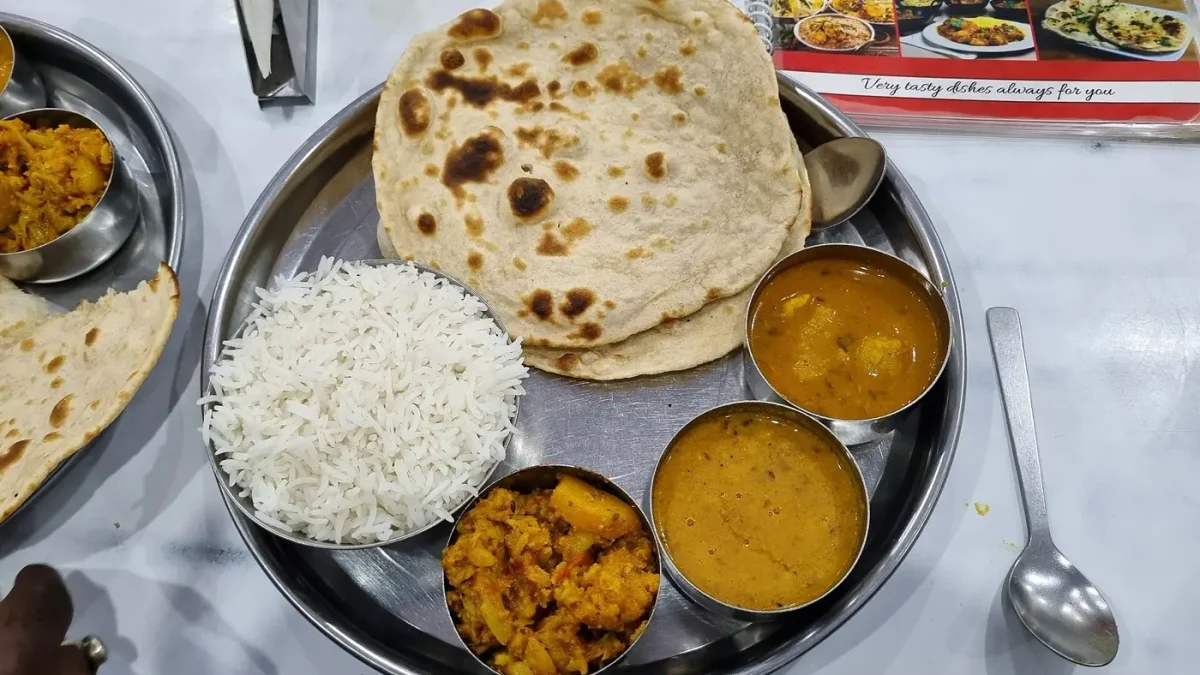
Featured image: Pure Indian dish containing Tandoori Rooti, rice, vegetables curry and others.jpg by Billjones94, CC BY-SA 4.0, via Wikimedia Commons
Key points
- The guidelines say that a large share of India’s disease burden is linked to unhealthy diets, and that healthy diets and physical activity can prevent a substantial proportion of coronary heart disease, hypertension and type 2 diabetes.
- NIN illustrates a balanced day’s food as a plate in which vegetables, greens and roots plus fruits make up about half, cereals and millets around a quarter or less, and pulses, eggs, meat or fish, nuts and milk products the rest.
- Indian meals are often heavy on refined cereals and low on pulses and vegetables.
What the guidelines are
In May 2024 the ICMR-National Institute of Nutrition (NIN), Hyderabad, released revised Dietary Guidelines for Indians. The document gives 17 guidelines covering a balanced diet, pregnancy and breastfeeding, children, physical activity, salt, oil, sugar, ultra-processed foods, water, food safety and reading labels. They replace the earlier 2011 edition.
The core message
The guidelines say that a large share of India’s disease burden is linked to unhealthy diets, and that healthy diets and physical activity can prevent a substantial proportion of coronary heart disease, hypertension and type 2 diabetes. They recommend eating a variety of foods, with cereals providing no more than about half of total energy, and getting more energy from pulses, beans, nuts, vegetables, fruits and dairy.
Key points for an Indian kitchen
- Eat a variety of foods across food groups every day, with plenty of vegetables and fruits.
- Limit salt, and reduce sugar and ultra-processed foods high in fat, sugar and salt (HFSS).
- Use oils and fats in moderation and rotate different oils.
- Prefer whole grains and millets over refined flour.
- Drink safe and clean water.
- Read food labels to make informed choices.
- Stay physically active every day.
The ‘My Plate for the Day’
NIN illustrates a balanced day’s food as a plate in which vegetables, greens and roots plus fruits make up about half, cereals and millets around a quarter or less, and pulses, eggs, meat or fish, nuts and milk products the rest. It is a visual guide, not a fixed meal plan.
Why it matters
Indian meals are often heavy on refined cereals and low on pulses and vegetables. Small changes, such as adding a bowl of dal and a cup of sabzi, swapping some white rice for millets, and cutting packaged snacks, move a typical diet much closer to the guidelines.
As of October 2026. Rules, prices and shop details change. Check the sources below before you rely on them.
Related reading
- Millets in the Indian diet: jowar, bajra, ragi and more, and how to cook them
- How to cut salt in Indian cooking without losing flavour
- Protein for Indian vegetarians: dal, paneer, soya and the food-first approach
Frequently asked questions
Who published the 2024 Dietary Guidelines for Indians?
The ICMR-National Institute of Nutrition, Hyderabad.
How many guidelines are there?
Seventeen.
Do the guidelines recommend protein supplements?
No. They advise against protein powders for most people and favour getting protein from food.